Quick answers
What causes a foggy window and can it be fixed?
If your window looks cloudy inside the glass, the sealed unit may have failed. It can often be fixed by replacing the glass unit, not always the whole window frame.
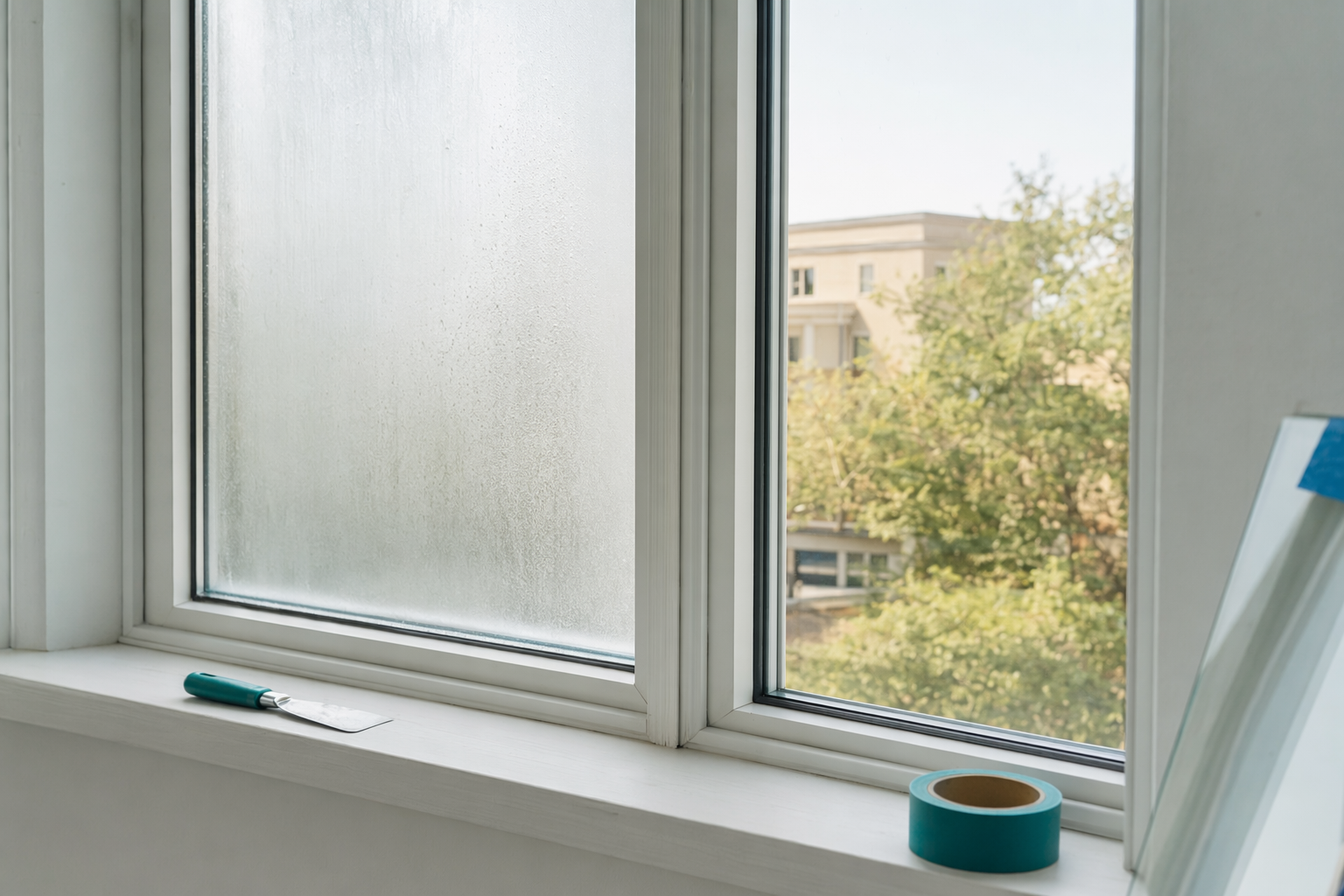
What to do right now
A foggy window is usually not an emergency, but check it once to make sure the glass is safe.
- Look for cracks, chips, loose pieces, or water leaking around the frame.
- If glass is broken, keep people and pets away, avoid touching sharp edges, and get first aid or call the local emergency number first if anyone is cut.
- If the glass is only foggy, note which window it is and whether the haze is between the panes or on the room side.
- Take a few photos in daylight. This helps when you ask a licensed, insured local glass pro about repair or replacement.
Clearpane is a free matching service, not a glass company or contractor. We can help you connect with licensed, insured local glass pros through get matched.

What usually causes a foggy window
Most foggy windows happen because a double-pane window seal has failed. A double-pane window, also called an insulated glass unit or IGU, has two pieces of glass with a sealed space between them. When that seal breaks down, moisture can get inside the space and create fog, haze, or water spots that you cannot wipe away from either side.
Heat, sun, age, and weather can all wear out the seal over time. In some homes, strong temperature swings, old spacers, or frame movement also play a part. Sometimes the window may look clear in the morning and foggy later, or the fog may come and go before it becomes permanent.
Not every cloudy window has a failed seal. Sometimes it is just surface condensation on the inside of the room-facing glass, often from cooking, showers, or indoor humidity. If you can wipe the moisture off with a cloth, it is not inside the sealed unit.
Single-pane windows are different. They have only one piece of glass, so they do not get "foggy between panes" because there is no sealed gap between two panes. They can still get surface condensation, but that is a different problem.
Can a foggy window be fixed?
Yes, often it can. In many homes, the fix is to replace the insulated glass unit inside the existing frame rather than replacing the entire window. That can be simpler and less expensive if the frame, sash, and hardware are still in good shape.
If the frame is badly damaged, rotted, bent, leaking, or no longer holds the glass properly, a pro may recommend a larger repair or full window replacement. But be careful with anyone who pushes a whole new window right away without clearly explaining why the glass alone cannot be replaced.
Some companies offer defogging or drilling services. These may improve the look for a while, but they do not always restore the original insulation value or solve the underlying seal failure. Ask exactly what is being done, what the expected result is, and get the price in writing before work starts.
Because homes vary, a licensed glass pro should confirm what type of unit you have and whether glass-only replacement is an option. Clearpane only provides general information and free matching help through help and get matched.
Glass types in plain English
Single-pane glass means one sheet of glass. It is common in older homes, sheds, garages, or some storm windows. It is usually less expensive to replace than double-pane glass, but it does less to reduce heat, cold, and outside noise.
Double-pane glass means two sheets of glass sealed together with an air or gas space in between. This is the type that commonly develops fog between panes when the seal fails. The replacement cost depends a lot on the size, thickness, coatings, and whether the glass is standard, tempered, or laminated.
Annealed glass is standard glass. It can break into sharp pieces. Tempered glass is safety glass that is heat-treated so it breaks into many smaller pieces. Local building codes often require tempered or other safety glass in doors, shower enclosures, and some low or large windows near walking areas. Laminated glass has a plastic layer between sheets and can hold together when broken.
A pro should verify the correct replacement type. Do not assume any piece of glass will do, especially near doors, tubs, showers, stairs, or large low windows where safety glass may be required by local code.
How much does it cost to fix a foggy window?
For a foggy double-pane window, many homeowners are really paying for replacement of the insulated glass unit, not just a quick cleaning. A common rough range for residential glass-only replacement is about $200 to $600 for a smaller, straightforward unit, and around $600 to $1,200 or more for larger, thicker, tempered, laminated, specialty-coated, or hard-to-access units. These are general ranges, not quotes.
If the window is single-pane, replacement may cost less. If the job involves custom sizes, grids, unusual shapes, patio door glass, high floors, emergency service, or code-required safety glass, the price can go up. Area matters too, and labor rates vary across the US.
Ask what is included: measuring, removal, disposal, glass type, safety glass if needed, and any trip or rush fee. The real number depends on single-pane vs double-pane, annealed vs tempered vs laminated, size, thickness, edge work, coatings, and your location. For more plain-language price guidance, see costs.
A fair company should be willing to explain whether they are replacing only the failed glass unit or recommending a full window replacement, and why.
How to choose a local glass pro without overpaying
When a window is foggy, there is usually time to compare options. Ask whether the company is licensed and insured for residential glass work in your area, and ask for the total price in writing before work begins. You stay in control: compare quotes, choose who to hire, and confirm the glass looks right before paying the final amount.
Red flags include vague pricing, scare tactics, cash-only demands, refusing to explain the glass type, and pressure to replace the whole window when only the glass may need replacing. Another red flag is saying a price is "today only" or refusing to put the scope of work in writing.
It helps to ask simple questions:
- Is this likely a failed double-pane seal or just surface condensation?
- Can the insulated glass unit be replaced without replacing the whole frame?
- What type of glass will you install: standard, tempered, or laminated?
- Is the price for glass only, or for full window replacement?
- Are measuring, installation, and disposal included?
Clearpane is free for the household. We only collect contact and project details such as your name, phone, optional email, project type, ZIP code, and preferred language so we can help connect you with local pros. You can learn more in our guides or get matched.
A foggy window usually means the seal in a double-pane glass unit has failed, and many times the glass can be replaced without replacing the whole window.
Common questions
Why is my window cloudy but I can't wipe it off?
If the haze is between two panes and will not wipe off from either side, the seal in a double-pane unit may have failed. Moisture gets into the space between the panes and causes fog or mineral spotting.
Do I need to replace the whole window if it is foggy?
Not always. In many cases, a licensed glass pro can replace just the insulated glass unit inside the existing frame if the frame and sash are still in good shape.
Can a foggy window be cleaned from the inside?
If the fog is inside a sealed double-pane unit, ordinary cleaning will not fix it. If the moisture is only on the room side of the glass, that is surface condensation and can usually be wiped away.
How can I tell if I have single-pane or double-pane glass?
Look at the edge of the glass from the side. If you can see two layers of glass with a small gap between them, it is likely double-pane. One layer only is single-pane.
Is a foggy window dangerous?
Fog alone is usually more of a visibility and efficiency problem than an emergency. But if the glass is cracked, loose, or leaking, keep people away from it and contact a licensed, insured glass pro.
How long does foggy window repair take?
It depends on the glass type, size, whether it is custom, and local availability. Some jobs move quickly, while special-order units can take longer, so ask for the expected timeline in writing.